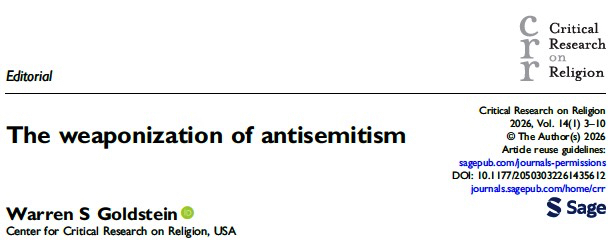
17 Apr 0 Warren S Goldstein, “The Weaponization of Antisemitism” Posted by admin Critical Research on Religion, CRR Volume 14, Issue 1 https://journals.sagepub.com/doi/10.1177/20503032261435612 Read More
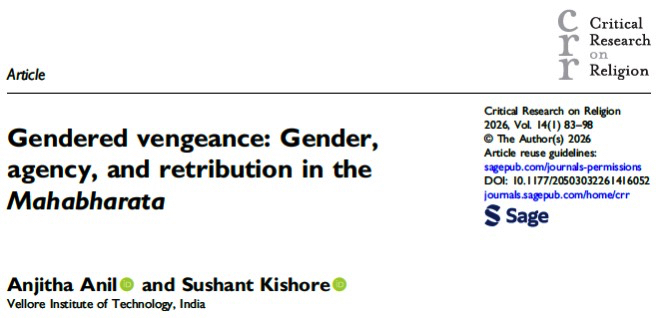
17 Apr 0 Anjitha Anil and Sushant Kishore, “Gendered vengeance: Gender, agency, and retribution in the Mahabharata” Posted by admin Critical Research on Religion, CRR Volume 14, Issue 1 https://journals.sagepub.com/doi/full/10.1177/20503032261416052 Read More
17 Apr 0 Himanshi Shinde and Mamta Anand, “Thus spoke the stone women, Ahalya and Galatea: A comparative study of classical myths and their modern feminist retellings by Kavita Kane and Madeline Miller” Posted by admin Critical Research on Religion, CRR Volume 14, Issue 1 https://journals.sagepub.com/doi/full/10.1177/20503032261416050 Read More
17 Apr 0 Azam Sarwar and Muhammad Safdar, “Disinformation and misinterpretation: Deconstructing the politics of denialism on social media in Pakistan through Islamic feminism” Posted by admin Critical Research on Religion, CRR Volume 14, Issue 1 https://journals.sagepub.com/doi/full/10.1177/20503032251381328 Read More
17 Apr 0 Ali Akbar and Abdullah Saeed, “Inclusivist discourses among contemporary Shia religious scholars about people of other faiths” Posted by admin Critical Research on Religion, CRR Volume 14, Issue 1 https://journals.sagepub.com/doi/full/10.1177/20503032261416046 Read More
17 Apr 0 Siyaves Azeri, “Conspiracy theories, fetishism, and the spiritual crisis: Marx on religion revisited” Posted by admin Critical Research on Religion, CRR Volume 14, Issue 1 https://journals.sagepub.com/doi/full/10.1177/20503032251381336 Read More
17 Apr 0 Simon Schmalen and Thomas Kron, “Confession and grooming: A risk analysis” Posted by admin Critical Research on Religion, CRR Volume 14, Issue 1 https://journals.sagepub.com/doi/full/10.1177/20503032251381297 Read More
19 Dec 0 Anonymous, “Where the poem meets the battlefield: Speaking of Palestine and Israel” Posted by admin Critical Research on Religion, CRR Volume 13, Issue 3 https://journals.sagepub.com/doi/full/10.1177/20503032251381334 Read More
19 Dec 0 Mehdi Nourian, Hassan Chavoshian, and Hamid Ebadollahi-Chanzanagh, “From ressentiment to revengefulness: An analysis of the discourse of baraʿatı Shıʿism in Iran” Posted by admin Critical Research on Religion, CRR Volume 13, Issue 3 https://journals.sagepub.com/doi/full/10.1177/20503032251381317 Read More
17 Dec 0 Abolfazl Morshedi, “Theoretical perspectives on Ṭabāṭabāʾī’s constructional conceptions: Islamic tradition and modernity in the Iranian context” Posted by admin Critical Research on Religion, CRR Volume 13, Issue 3 https://journals.sagepub.com/doi/full/10.1177/20503032251381307 Read More